Monday, 21 November 2016

Tipping Point II - Circulation Change

This week, I will be outlining research and modelling exercises on the potential shutdown of the Atlantic Meridional Overturning Circulation (AMOC), also known as the Thermohaline circulation. 

Thermohaline Circulation (THC)

The thermohaline circulation, popularly called the global ocean conveyer belt, is an integral feature of the present day climate system. It sustains the current climate and is a major contributor to the global heat budget. As illustrated in Fig 1,  global oceanic circulation is driven by density gradients related to the formation of deep water. The density of seawater is governed by temperature and salinity. The THC process is briefly outlined below (Broecker 1997):
  1. Warmer, saltier water brought into NE Atlantic, warms the European continent
  2. Warm water cools and mixes with cold Arctic water, becomes dense and sinks, forming North Atlantic Deep Water 
  3. Further sinking of dense water occurs near Antarctica with cool water sinking from the effect of the circumpolar currents, forming Antarctic Bottom Water 
  4. Cold dense water returns to the surface throughout the world's oceans and forms a closed loop of exchanges between warm, surface water and cool, dense deep water

Modes of THC

Driven by density differences, the THC is particularly sensitive to the freshwater budget which will disrupt overturning of deepwater by reducing salinity. Looking in past abrupt changes to the THC, scientists have identified three possible modes (stable states) with fundamentally different climates (Rahmstorf 2000):
  1. Warm - interglacial (current) mode where deep water forms in Nordic Seas 
  2. Cold - glacial mode where deep water forms south near Greenland, Iceland and Scotland
  3. Off - shutdown of THC, no formation of deep water in North Atlantic
Transitions between modes would cause abrupt climate changes. Previous transitions between modes have occurred in the form of Dansgaard-Oeschger cycles and Henrich events where large scale breakdown of N Atlantic icebergs dramatically increases freshwater input (Alley 2000). 


Tipping Point

As the thermohaline circulation is driven by density differences which are particularly sensitive to temperature and salinity, both sufficient heat from continued increase in GHG concentrations and alteration of the freshwater budget from melting ice can lead to fundamental re-organization of ocean circulation and transition to a alternative state (Clark 2002). Classified as being 'low probability with high impacts' by the IPCC, a critical threshold may be observed with hysteresis characteristics from non-linear behaviour. Modelling studies using coupled atmosphere-ocean General Circulation Models have suggested that the THC is particularly sensitive to freshwater infiltration on the order of 0.1 Sv with a transition across critical threshold within range between 0-0.15 Sv (Clark 2002; Rahmstorf 2000).

Modelling responses of the THC to rising CO2 concentrations with warming and melting ice effects, Wood et.al. 1999 proposed that a shutdown of convection in the Labrador Sea would result in a 20-25% reduction in deep water formation by the time CO2 quadruples pre-industrial levels. Salinity in the Nordic seas declined since the 1960s, suggesting a possibility of critical threshold of freshening in this century (Curry and Mauritzen 2005). A 20th century slowing down of the AMOC was witnessed by a region of cooling in Northern Atlantic after 1970 due to increased freshwater input with further uncertainty from melting of the Greenland ice sheet (Rahmstorf et.al. 2015). 

Impacts

The impacts of a THC tipping point has been widely studied with models and experiments. A shutdown of AMOC would lead to cooling effects which may outweigh and reverse current CO2 induced temperature trends whereas a AMOC weakening are dominated by increased CO2 domination (Yin et.al. 2006). Using the Met Office HadCM3 GCM in a modelling experiment, an artificial collapse of the AMOC in 2049 would cause reduction in precipitation in Western Europe and a regional cooling of the Northern Hemisphere by -1.7 degrees with up to -9 degrees cooling locally. Global primary production from vegetation will also decrease by 5% due to temperature and moisture changes. Drying trends will also be noticed in Central America and SE Asia with impacts extending globally within 30 years (Vellinga and Wood 2003; Vellinga and Wood 2008)

Causing the shutdown of the THC would no doubt constitute as 'dangerous level of interference' (Hansen et.al. 2006), possibly characterising the Anthropocene epoch. The uncertainty in coupled GCMs on the full range of feedback responses and the 'low probability' claim of the IPCC is certainty not an excuse for inaction and a shutdown in the current century should not be ruled out. This also highlights the need for better oceanic monitoring equipment and research to ensure development of early warning systems and proper anticipation of global impacts.

Thank you for reading this post! In the next post, we will look at the possibilities of detecting critical thresholds.

Friday, 11 November 2016

Tipping Point I - Melting Ice


Welcome back! This has definitely been an eventful week! It started off well with the release of Leonardo Dicaprio's Before the Flood documentary but ended disastrously with the electoral victory of a climate sceptic as President of the United States. I hope that those in power would recognize the consensus of anthropogenic climate change and the increasing likely reality of irreversibility and impending tipping points. 

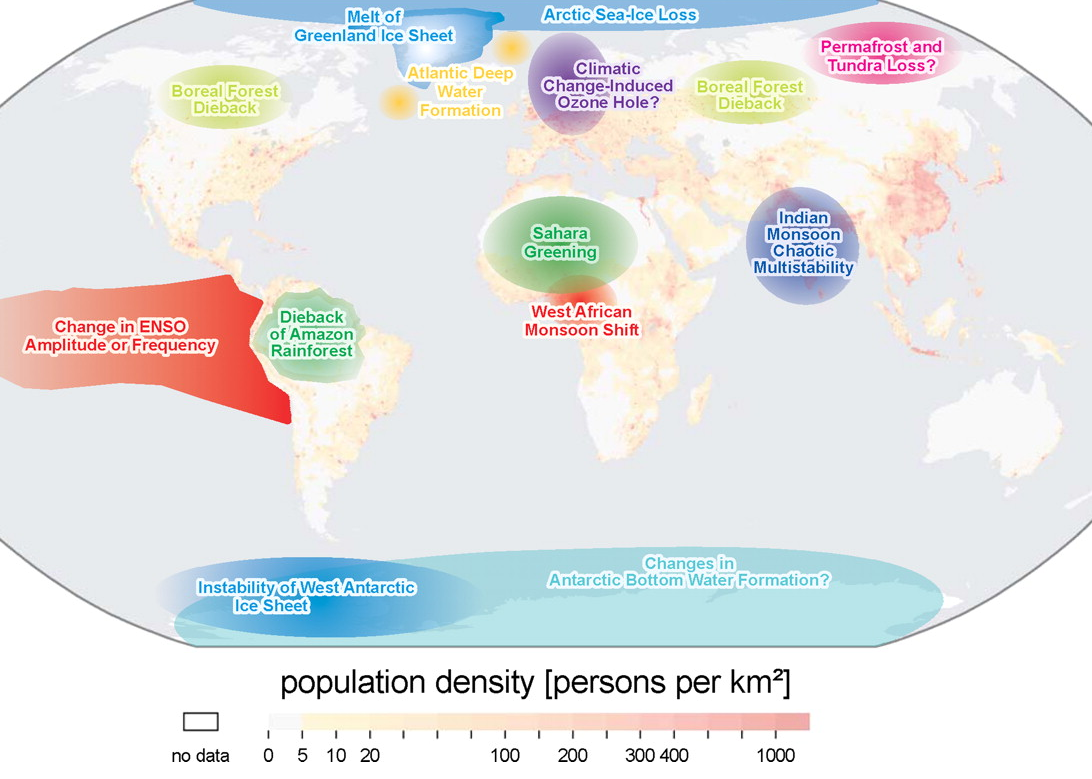
In one of the first comprehensive study of tipping elements in the climate system, Lenton et.al (2008) identified 8 major scientifically probable tipping elements regional to global implications. Three major classes of tipping elements were identified as shown below:

1. Melting Ice
2. Circulation Change (Atmospheric and Oceanic)
3. Biome/Ecological Loss

It should be noted that by separating tipping elements in distinctive classes does not necessarily mean that tipping elements operate independent of each other but are instead interconnected to each other and other areas of concerns. I will first be focusing on the Arctic as it has the greatest number of identified potential tipping elements across the three classes. In this post, I will focus on melting ice and in particular the current status of Arctic Sea Ice. 


Arctic Ice Sheet

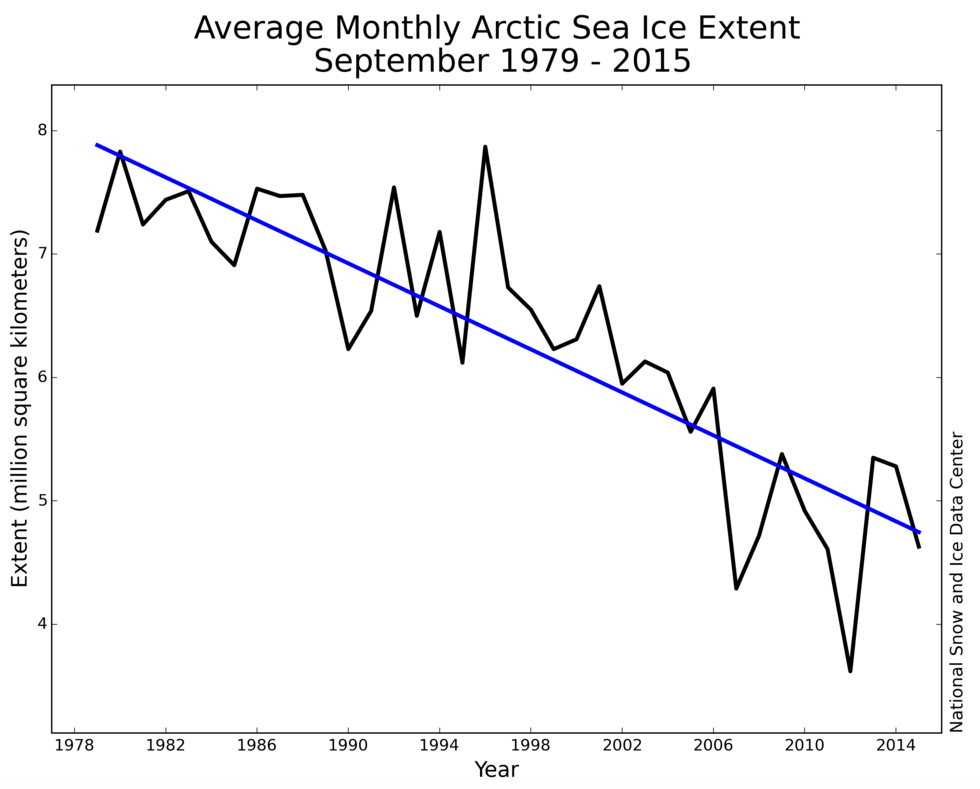
The Arctic ice sheet is highly sensitive to climatic changes. Considerable thinning, record minimum in multi-year ice extent and a declining in summer (September) sea ice extent have all been observed in the past century (Holland et.al. 2006). Six of the lowest summer ice extent in satellite history had been observed in the period between 2007 and 2012 (Livina and Lenton 2012). Observations and model simulations have shown, with relatively high certainty, the presence of a critical threshold by which summer ice would permanently disappear. 

Source

Warming in Arctic temperature affects the entire suite of ice-ocean system and may have the potential to cause rapid changes in the earth system. The dominance of positive feedbacks in the Arctic is instrumental in amplifying warming and accelerates ice retreat and thinning, resulting in possible ice-free summer conditions. This has been termed 'Arctic amplification' and has largely been used in paleoclimatology. Outlined below are the three major positive feedback loops amplifying rises in global mean sea surface temperature and subsequently drives rapid decline in thickness and extent of sea ice (Miller et.al. 2010): 

1. Ice-Albedo Feedback - Fresh snow and sea ice has the highest albedos (reflectivity of solar radiation) of any land surface on Earth. 

Increases in temperature from anthropogenic warming --> reduction in seasonal/areal extent of sea ice --> increase exposure of open ocean--> reduction in albedo -->  stronger absorption of solar radiation --> further rise in sea surface temperature

2. Vegetation Feedback - Tundra and vegetated lands are abundant in Arctic inlands and can contribute to warming through positive feedbacks

Seasonal reduction in extent and duration of snow cover --> increased vegetation response with advancement of dark shrubs --> reduction in albedo -> stronger absorption of solar radiation --> further rise in sea surface temperature

3. Permafrost Feedback - Large stocks of methane hydrates are present in continental shelves of the Arctic. It is also a carbon sink in recent decades (McGuire et.al. 2009)

Warming melts ground ice --> extensive permafrost thaw --> release of frozen carbon and methane into the atmosphere --> accelerate rate of climate change 


It is therefore clear that these positive feedbacks may induce non-linear behaviour which, at a critical threshold, may tip the entire system into a qualitatively different state. Non-linear shrinking and thinning of Arctic sea ice have been observed since 1988, leading to some suggesting that a critical threshold has already been passed. Lindsay and Zhang (2005) suggested the dominance of internal system response over response to external forcing since 1989 beyond which positive feedback loops were increasingly capable of triggering initiation of continual rapid thinning and shrinkage even when external forcing remained relatively unchanged. Other studies have employed an alternative definition of tipping point in terms of summer sea ice extent but are in agreement about the role played by ice-albedo feedbacks and open water formation.  Using 7 ensemble model simulations from the IPCC, there was general agreement that reduction in summer sea ice is a universal feature in the 21st century with a 60% decrease in sea ice in a decade and summer ice-free conditions by 2040 (Fig.1) (Holland et.al. 2006). Furthermore, some even suggests impending year round ice-free conditions when polar temperature rises above -5 degrees and positive feedbacks disturbs linear relationships between sea ice and climate (Winton 2006). 

Fig.1 Critical threshold at around 2040 with ice-free conditions in
the summer in 7 runs of ensemble models in the IPCC AR4 report
However, some have suggested that ice extent recovers and a tipping point is unlikely to exist in the foreseeable future. It was suggested that positive ice-albedo feedbacks are not permanent and anomalous summer ice loss is reversible by large-scale recovery mechanisms. Anomalous summer ice loss due to positive ice-albedo feedbacks are reversed when anomalously warm atmosphere causes increased heat loss and decreased heat gain adaptations at the top of the atmosphere (Tietsche et.al. 2011). It is therefore clear that there are considerable uncertainties in whether or not a certain critical threshold exists and whether it has already been passed or not. To sum up, Duarte et.al. (2012) raises an important point that descending into a semantic argument of what constitutes a tipping point in Arctic sea ice loss and whether or not a threshold has been passed detracts from the urgency of the situation and the need to avoid the increasing reality of dangerous climate change in the Arctic. 


Wednesday, 2 November 2016

Political Tipping Point

The US presidential election across the pond is only one week away! Climate change had never featured this much in a presidential election before. From asserting that climate change is the biggest threat to national security by Bernie Sanders to outright rejection of climate science by Donald Trump, it is fair to say that the next decade of global environmental cooperation depends on this historic election.

I came across an open letter sent by >300 scientists and 30 Nobel laureates warning of the serious risks of climate change and the consequences of opting out of international climate cooperation. The letter highlights the consensus in the presence of climate tipping points and the risks of inaction. 

"We know that the climate system has tipping points. Our proximity to these tipping points is uncertain. We know, however, that rapid warming of the planet increases the risk of crossing climatic points of no return"

Just like the climate system, 'the political system also has tipping points'. Handing over power to a president who believes climate change is an invented hoax and a vice president who have received large amounts of his campaign money from donors in the fossil fuel industry would represent a political tipping point where global environmental cooperation are undermined and downplays the urgency of impending climate crisis. 


Tuesday, 1 November 2016

Are we doomed?

I recently stumbled across this video taken from 'Disruption', a climate change documentary premiered in 2014. It is a very nice introduction to three major and arguably most urgent climatic tipping points which are scientifically probable and will have regional to global impacts. It is also a nice video to introduce you all to the next part of my blog where I will delve into the scientific basis of the various tipping points. 


Enjoy the video! My next post will be on the first climate tipping point - potential tipping behaviour of the Arctic sea ice. 

Monday, 31 October 2016

Integrated Assessments of Tipping Points - Societal Tipping Points

I came across a recently published paper by Kopp et.al. (2016) which effectively clarifies the multitude of terms used in characterizing tipping points and introduces integrated thinking to link interactions between tipping points and society. For all you human geographers out there, I aim to evaluate and summarize the author's findings and introduce the concept of societal tipping elements which will be explored in future posts.

The authors adopted the definition of climatic tipping point and tipping elements proposed by Lenton et.al. 2008 (mentioned in the last blog post) but identifies a glaring gap in the current discourse of tipping points. The authors identifies that the link between changes in the physical earth system and subsequent socio-economic consequences are either non-existent in scientific research or are often unclear. Socioeconomic tipping points are defined as the critical threshold at which the resilience of social systems (subjected to positive feedback loops) are breached and adaptative options/response exhibit nonlinear and exponential change. System inertia means that considerable change may already be committed but critical thresholds may be realized and passed at a later date. This will either have considerable socioeconomic impacts if certain climate tipping elements are triggered abruptly or may render certain consequences as irrelevant if realized change occur in millennial scale. The authors proposed 4 socioeconomic tipping elements which may be beneficial or detrimental to human wellbeing:
1. Technology - Technological diffusion and exponential growth in adaptive technology
2.  Civil Conflict - Failure to adapt lead to lower resilience and increased risks of civil conflict
3.  Migration - Climate-induced migration and forced displacement
4. Environmental Policy - long-term incremental policy changes interrupted by abrupt change to new policy state/Change in public opinions
The authors also suggested looking back at historically large scale economic tipping points/shocks in order to identify possibly climate-linked causes which may consist of socioeconomic/climatic tipping elements. Possible economic shocks may include banking crises, environmental disasters, sluggish growth rates, international warfare or political restructuring. These historical economic shocks may help date the onset of certain tipping points of tipping elements and may provide valuable information to determine trade-offs or linkages between different tipping elements (eg. Extreme weather/change of state in regional atmospheric circulation may threaten global financial systems or induce migration and ultimately induce international warfare).

Changing population of British Banks -
example of historical socioecnomic tipping point as
suggested by Bentley et.al 2014
All identified socioeconomic tipping elements may cause exponential growth rates in certain societal response when a critical threshold is breached and economic shocks are induced. Kopp et.al. 2016 introduces socioeconomic tipping elements as elements likely to be triggered by the breaching of certain climatic tipping points and suggests convincingly that these non-linear socioeconomic responses will be evidence of the trajectory in which human society might go in the future. While the date of such critical thresholds for these future socioeconomic tipping elements are difficult to determine, or even impossible to define, assessments which integrates climatic tipping elements with socioeconomic tipping elements and economic shocks are needed to adequately assess the costs/risks of climate change and identify possible reasons for action/inaction.

Thursday, 27 October 2016

Apocalypse?

Welcome back! Before I discuss the scientific studies on potential tipping points, I wish to discuss the use of the term and the public discourse it created (for all you human geographers out there). In this post, I aim to discuss possible implications/pitfalls  of tipping points in science communication. Arguments across the physical and social sciences have argued against the portrayal of climate change using overly apocalyptic language and questions have been raised to whether it is scientific probable for tipping points to be global in scale and non-climatic. 

'Discourse of catastrophe' (Hulme, 2006)

The often obsession with the idea of potential tipping points and the constant usage of exaggerated rhetoric and language of fear in media is not without controversy. In one of the most public criticism of the current environmental change discourse climatologist and former director of the Tyndall Centre for Climate Change Research, Prof. Mike Hulme points out under the current discourse, climate change are often presented as being catastrophic to be worthy of any media and public attention. Claiming that the apocalyptic view of environmental change are merely language of fear rather than the language of science, Hulme argues that it would lead to weakened communication and willingness for behavioural change. Ending on a rather depressing note, Hulme worries that this 'discourse of catastrophe' may lead to inaction and usher society along a negative, reactionary trajectory. While I believe that this portrayal of climate change is not the most effective way to encourage action, I do think that Hulme's claims that the language of catastrophe is not used in science is untrue. Discerning whether the current discourse is one grounded in scientific truth, Risbey (2008) rightly identified that empirical and theoretical science aiming to describe urgency and threat does contain terms and rhetoric which are described as not being the language of science by Hulme. It is also not sensible to disregard genuinely catastrophic consequences as whether or not consequences from critical thresholds are considered catastrophic differs in different locations, to different people and at different times. Impacts of anthropogenic activities on climate change can be therefore be projected and described scientifically as 'alarming' without being automatically equated to 'alarmist'.

Another potential pitfall of constant discussion on abrupt climatic tipping points is the subsequent emphasis on technocratic solutions. The more urgent an issue is presented as being, the more attention is paid on technological and anthropocentric solutions to ensure 'business as usual'. As Crist (2007) identified, instead of changing the means at which the current social organisation operates, the focus on technological fixes may detract importance from other environmental challenges which cannot be tackled via technological means (eg. biodiversity loss/species extinction). This dominant framing of climate change may therefore have led to 'techno-arrogance' and an increasing perception that geoengineering are reasonable and inevitable. There is therefore a need to recognise that non-climatic elements (biosphere integrity, plastics and other planetary boundaries) are fundamentally impacted by anthropogenic activities independently from climate change and would not be tackled under the prevailing discourse of technical solutions (eg. renewable energy, carbon sequestration). 


The Way Forward

I hope this post will highlight the controversy surrounding the issue of tipping points. A semantic debate on the meaning of global tipping points does indeed risk diverting attention away from local/regional policies or mitigation actions. Finally, a shift in language from asserting whether something will happen, which may easily be reduced as alarmist, to when and the time range in which it could happen (Maslin and Austin 2012) would ultimately be a much more effective way to stimulate planning and action to impending thresholds. 

Thursday, 20 October 2016

'Little things can make a big difference'

Welcome back to my blog! In this post, I will endeavour to discuss the emergence of 'tipping point' as a concept in mainstream scientific communication and public discourse. 

Emergence of Tipping Points


The basic principle behind climatic tipping points can be attributed to the journalist/sociologist Malcolm Gladwell. In the 2000 book 'The Tipping Point', Gladwell theorized the presence of sudden, dramatic shifts in sociological/behavioural phenomena under the influence of rapidly spreading ideas and messages, popularizing the notion that 'little things can make a big difference'. This was subsequently quoted directly in Lenton et.al. (2008), one of the first comprehensive review of climatic tipping points. The widespread emergence of tipping points in mainstream scientific literature and public discourse on climate change can be traced back to a 2005 American Geophysical Union address by world renowned climate scientist James Hansen in which climate tipping points were defined as irreversible critical points (Russil and Nyssa 2009). Scientific research on global climate change prior to the mainstreaming of tipping points rarely appreciate the full range of outcomes. 'Climate alarmism' were often used to describe the very few assessments which considered events defined as 'low probability' but with extreme consequences (Schneider 2004). Since Hansen's 2005 address, tipping points have since been a major part of climate research and scientific communication. It was included in the latest IPCC report with scientists concluding with medium confidence that a continued rise in temperature will increase the risk of crossing climatic thresholds and thereby triggering abrupt and irreversible changes (IPCC 2014).

Defining Tipping Points

Theories and modelled results previously described as being too uncertain and alarmists are now considered mainstream and scientific. A plethora of different terms with slightly different or overlapping meanings had emerged since in mainstream scientific literature. These terms may include 'dangerous climate change', 'state shift', 'regime shift', 'abrupt change' and 'threshold' and their uses are often rather confusing and chaotic (Lenton 2013). All of which recognize the enormity of anthropogenic influence but may differ in terms of irreversible conditions, hysteresis and abruptness. While I realize that descending into a semantic debate about the definition of tipping points detracts from the urgency of the situation, it is definitely advantageous to identify some key differences between the terms from which I will adopt a general definition which future posts will be based upon. Listed below are definitions of the most used terms with some overlapping elements:
  • Tipping Element - policy-relevant, subsystems that can be tipped into qualitatively different states by small, but significant perturbations (Lenton et.al. 2008
  • Threshold - critical point that once surpassed will trigger some kind of non-linear change
  • Regime Shift  - (Ecology) large, long-lasting re-organization of system structure to alternative stable state either through abrupt shock or gradual erosion of system strength by internal feedbacks or external influence (Biggs et.al. 2009). May be abrupt, smooth or discontinuous. (Can occur in social systems as well)

  • Hysteresis - Irreversible regime shift across multiple stable states where the ceasing of perturbation does not lead to system returning to its original state (Barnosky et.al. 2012)


  • Bifurcation - A change in equilibria possibly resulting in the transition to a new set of stable conditions which will inevitably lead to irreversibility (Barnosky et.al. 2012)
To avoid confusion, I will be referring to 'tipping point' as a term meaning potentially abrupt reversible (non-bifurcation) or irreversible change across social and environmental systems (across ecological, socio-economic, climatic). This definition, though simplistic, allows me to comment on elements with different tipping behaviour, going beyond some who may narrowly define tipping points (Barnosky et.al. 2012Lenton and Williams 2013).